What the June Mountain live cams show
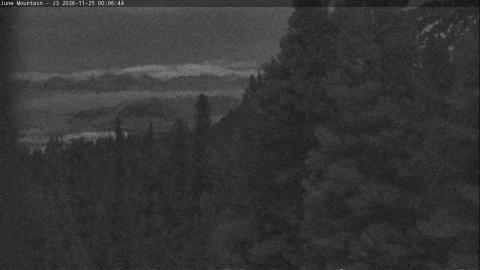
Ski runs through the forest under Chair J3
June Mountain's J3 camera looks up the mountain over the tops of firs and pines to two ski runs cut side by side through the forest, climbing toward the upper slopes. In late fall the first strips of man-made snow appear on these runs before anything else on the mountain turns white.
It is the camera to check for snow cover on the middle of the mountain: how wide and how white the runs are, whether the trees are loaded after a storm and how low the clouds sit.
The chalet and the high peaks from high on June Mountain
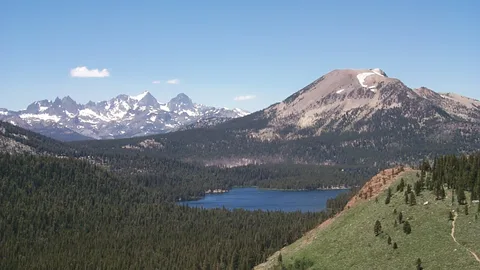
Mounted at a ski patrol post high on the mountain, this camera turns between two views. One looks down on the long timber building of the June Meadows Chalet, its deck and bridge, with the valley and distant ranges beyond; the other swings across to a massive peak of the Sierra crest, its ridges dusted with snow.
It is the best camera to judge the weather up high: whether the peaks are clear or wrapped in cloud, how much new snow fell on the ridges and how many people are out at the chalet.
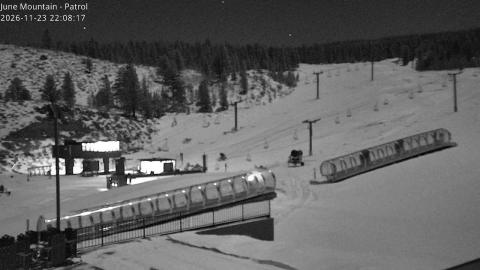
Lift terminals and service tracks at mid-mountain
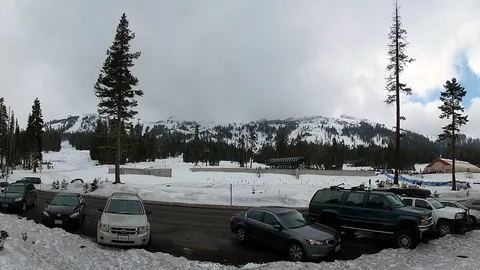
This camera stands on the open flat around the June Meadows Chalet, the mid-mountain lodge of the ski area. It turns between views: a terminal of Chair J2 with its lift shack, a blue sign and the emergency meeting point, and the gravel tracks and service buildings of the flat, with service vehicles and equipment waiting for the season.
Before the season it shows bare ground and pumice; in winter it shows the snow on the flat, the lift line at J2 and the grooming at first light.
Two summits above the June Lake Loop
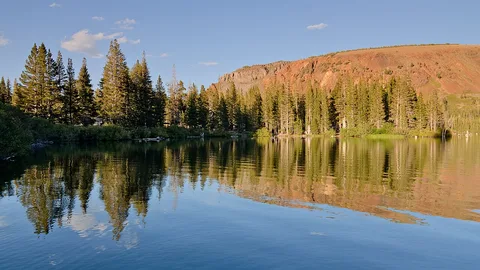
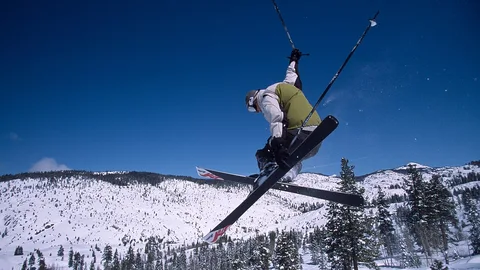
The ski area spreads over two summits, Rainbow Mountain at 10,044 feet and June Mountain at 10,095 feet, with about 1,500 acres, seven lifts and a vertical rise of 2,545 feet from the lower ticket office to the top. It averages around 250 inches of snow a year, and much of its terrain is gladed forest. Skiing at June Lake began with a rope tow in 1940, and the present ski area has run for more than half a century. In 2012 its owners announced it would close for the season; a campaign by the village followed, and June Mountain reopened for the 2013–14 season with investment in snowmaking and a chairlift. It is run together with Mammoth Mountain, 20 miles south.
When to watch June Mountain
June Mountain keeps Pacific Time, UTC−8 in winter and UTC−7 from March to early November. The sun rises between about 5:35 a.m. in mid-June and 7:20 a.m. in early March, and sets between about 4:40 p.m. in early December and 8:20 p.m. in late June. The cams are most useful in winter, in the morning before the lifts open, to see how much snow fell overnight and whether the clouds sit on the peaks. In late fall the runs under J3 show the first white strips of snowmaking; in summer they are bare and green.
Around June Mountain
The base lodge sits on Highway 158 just west of the village, near Gull Lake, so skiers can stay in town and drive or walk a short way to the lifts. Mammoth Mountain, 20 miles south on U.S. 395, has many more lifts and its own cams on the summit and the lodges.
Visiting June Mountain
From U.S. 395, take the June Lake Loop Road, State Route 158, at June Lake Junction and follow it through the village to the ski area. The lower ticket office sits about 7,550 feet up and the summits pass 10,000 feet, so altitude and cold wind are worth planning for. In storms, chain controls are common on U.S. 395 and the loop road; check conditions and the resort's own report before driving up.