Wyoming live cams
The Mammoth terraces and Yellowstone Lake, the Teton Range and the Town Square of Jackson: northwest Wyoming, live.
Tetons 4
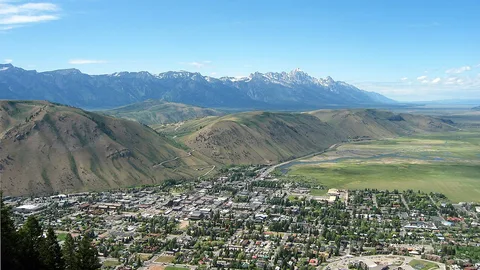
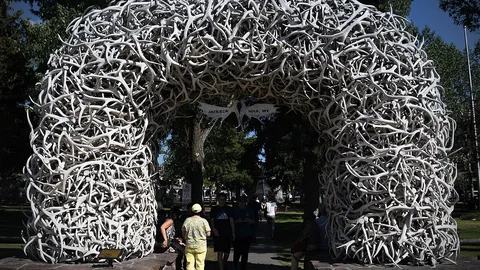
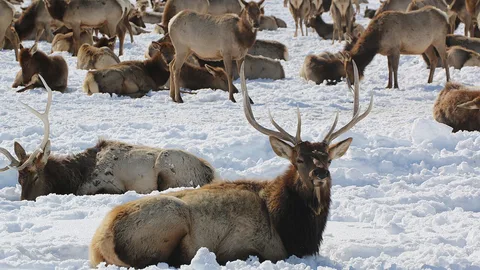
Jackson Hole and Grand Teton National Park: the antler arches of Jackson's Town Square, the town from the top of Snow King, the National Elk Refuge and the Teton Range from Moose and the ranches on the valley floor.

Yellowstone Country 1
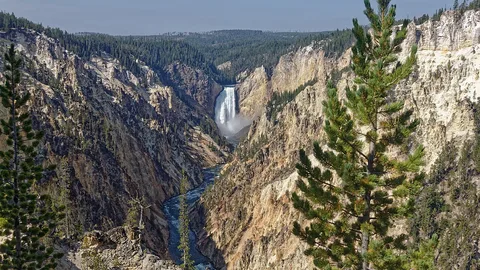
Yellowstone on camera: Mount Washburn both ways, the Mammoth terraces, Electric Peak, Yellowstone Lake, Biscuit Basin and three entrances.
No place matches this search.
Photos: authors and licences of the 5 images
- Yellowstone: Dirtsc, CC BY-SA 3.0
- Jackson Hole: Mlewis2005, Public domain
- Jackson Town Square: Schwerdf, CC BY 4.0
- Grand Teton: Acroterion, CC BY-SA 4.0
- National Elk Refuge: USGS, Public domain
High country of the northern Rockies
Wyoming is a state of high plains and mountain ranges, with the Continental Divide winding across it and fewer people than any other state. Its northwest corner holds Yellowstone, the first national park in the country, and just south of it Grand Teton National Park and the valley of Jackson Hole.
The first national park
Yellowstone sits on a volcanic plateau mostly between 7,000 and 8,500 feet, crossed by a figure-eight loop of park roads. The cams here cover its north end, from the North Entrance at Gardiner, Montana, and the travertine terraces of Mammoth Hot Springs to the fire lookout on Mount Washburn; its center at Yellowstone Lake; Biscuit Basin in the geyser country of the southwest; and two more gates, the West Entrance at West Yellowstone and the East Entrance on the road from Cody.
The geyser basins
The southwest of the park holds its densest geyser fields along the Firehole River. Old Faithful, in the Upper Geyser Basin, is what most visitors come to see; the camera here looks over Biscuit Basin, about 2 miles downstream.
Grand Teton and Jackson Hole
South of Yellowstone, the Teton Range rises straight out of the valley floor of Jackson Hole without foothills, to 13,775 feet at the Grand Teton. Park and ranch cams watch the peaks from Moose, Kelly and the valley around them, and in the town of Jackson, at the south end of the valley, cameras look over the antler arches of the Town Square, down from the summit of Snow King Mountain and across the National Elk Refuge.
Who runs the cameras
Most of the cams belong to the National Park Service, which publishes still images from its entrances, Mammoth and Mount Washburn. The Yellowstone Volcano Observatory of the U.S. Geological Survey adds its cameras at Yellowstone Lake and Biscuit Basin. In Grand Teton and Jackson Hole, most cams are streamed by See Jackson Hole, a local site, from hotels, ranches and businesses, with others from the Grand Teton National Park Foundation and the park service. Each one is credited on its page, with a link to its owner.
Wildlife and the seasons
Bison, elk and pronghorn graze the open valleys and the hills around the entrances, thousands of elk winter on the refuge beside Jackson, and wolves and grizzly bears roam the backcountry. Summer is short: snow can fall in any month at high elevations, and from early November until spring most of the park's roads close to regular cars, leaving the geysers to snowcoaches, snowmobiles and skiers.
Mountain Time and a cold climate
Wyoming keeps Mountain Time (UTC−7, and UTC−6 from March to early November), one hour ahead of the West Coast. At Yellowstone's elevation, summer days reach the 70s °F while nights drop near freezing, and winter lows often fall below zero.