What the Washington, D.C. live cams show
The north front of the White House across Lafayette Square
earthTV's camera looks south over Lafayette Square from the north side of the park and moves between a close and a wide framing. Close in, the gilded dome and weathervane of St. John's Church stand in the right foreground, Andrew Jackson rears on his bronze horse among the trees, and the white columned north portico of the White House rises beyond Pennsylvania Avenue, with the gray granite of the Eisenhower Executive Office Building on the right. Pulled back, the treetops of the square frame the house, its fountain and lawn, with the Washington Monument standing tall behind it and the towers of Rosslyn on the horizon.
It shows the comings and goings on Pennsylvania Avenue, and the house is lit after dark.
A capital built for the purpose
The Residence Act of 1790 let George Washington choose a site for a permanent capital on the Potomac, carved out of land given by Maryland and Virginia; the Virginia part was returned in 1846. Pierre L'Enfant drew its plan of diagonal avenues over a grid, with the Capitol and the President's House as its poles. The government moved here from Philadelphia in 1800, and John Adams was the first president to live in the White House, designed by the Irish-born architect James Hoban. British troops burned both buildings in 1814, and both were rebuilt. The District is not part of any state, and Congress has the final say over its laws.
Lafayette Square
The seven-acre park across Pennsylvania Avenue from the White House is part of President's Park. At its center stands Clark Mills's bronze of Andrew Jackson on a rearing horse, the first equestrian statue cast in the United States, and the four corners hold statues of foreign heroes of the Revolutionary War, among them the Marquis de Lafayette. On its north side, St. John's Episcopal Church, with its gilded cupola, has been attended by presidents since James Madison.
When to watch Washington, D.C.
Washington keeps Eastern Time, UTC−5 in winter and UTC−4 from March to early November. The sun rises between about 5:40 a.m. in mid-June and 7:35 a.m. at the end of October, and sets between about 4:45 p.m. in early December and 8:35 p.m. in late June. The White House is lit at night. Spring brings the cherry blossoms around the Tidal Basin, usually in late March or early April, and summers are hot and humid.
Around Washington, D.C.
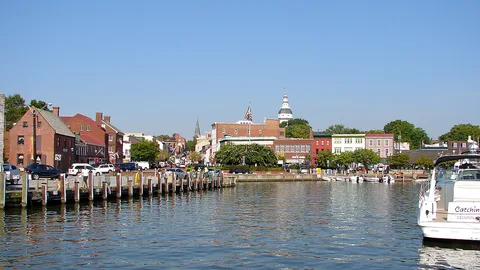
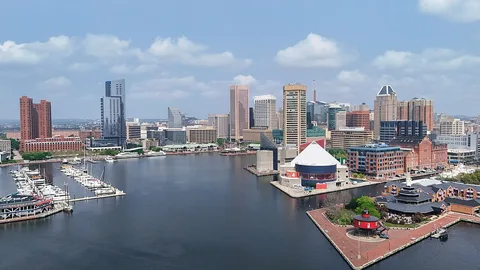
The Ellipse and the National Mall begin just south of the White House, with the Washington Monument and the Smithsonian museums. Georgetown is to the west, and Arlington National Cemetery lies across the Potomac in Virginia. Annapolis is about 30 miles east and Baltimore about 40 miles northeast.
Visiting Washington, D.C.
Reagan National Airport (DCA) is a short Metro ride from downtown; Dulles (IAD) and BWI are farther out, and Amtrak trains arrive at Union Station near the Capitol. The Metro covers most sights. Tours inside the White House must be requested through a member of Congress or, for foreign visitors, an embassy, well in advance; the view through the north fence, from the pedestrian stretch of Pennsylvania Avenue, needs no ticket.