What the Baltimore live cams show
Sharks, rays and a sea turtle in the aquarium's Indo-Pacific reef
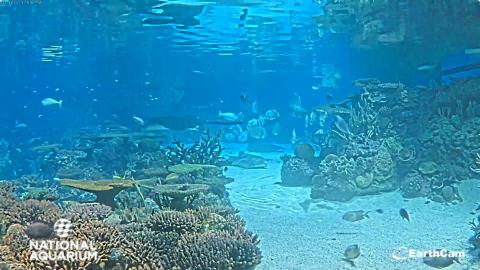
The National Aquarium points this camera into Blacktip Reef, a re-created Indo-Pacific reef holding about 275,000 gallons of water. The lens sits low on the reef, close to the sandy floor: coral heads and branching corals fill the right side, and in front of them unicornfish, tangs and angelfish cross back and forth, often close enough to fill the picture. Blacktip reef sharks cruise through the open blue water in the background, rays glide over the sand with their long tails trailing behind, and a sea turtle sometimes paddles past near the surface. Now and then a diver comes in to feed the fish or clean the tank. With dozens of species moving at once, the scene keeps changing; watch for a while and the sharks circle back.
Spotted jellies pulsing in blue light
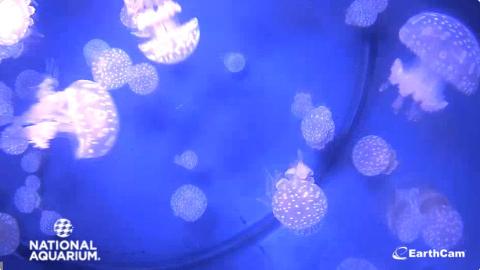
This one looks into a jelly tank in Jellies Invasion, the National Aquarium's gallery of jellies, almost all of them raised in the aquarium's own culture lab next door. The tank is lit a deep blue, and its curved wall crosses the picture as a dark arc. Pink, white-spotted bells drift past the lens, some so close they fill half the screen, others small and soft-edged in the background, with frilly arms trailing beneath. There is no surface, floor or coral to fix the eye, only jellies rising, turning and sinking at their own slow pace, which is what makes it so easy to leave running. It is the calmest of the aquarium's three cams.
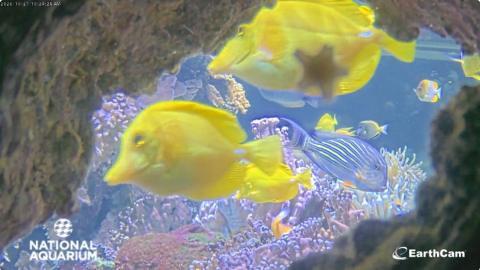
Tangs and butterflyfish in a Pacific coral reef tank
The third camera peers through a gap in the rockwork of the Pacific Coral Reef, the last habitat in the aquarium's North Atlantic to the Pacific exhibit. Dark, rough rock frames the view on both sides like the mouth of a small cave, and through it the reef spreads out in lilac and cream corals and anemones. Bright yellow tangs, blue tangs, butterflyfish striped in black and yellow, and small orange anthias drift between the coral heads. It is a smaller, more colorful tank than Blacktip Reef, and the fish often swim right up to the lens. A clock in the top corner shows the local time of the picture.
A working port that turned to its waterfront
The town was founded in 1729, and its port, older still, carried tobacco and later grain to Europe. By the 1950s the Inner Harbor was a tired edge of rotting piers, and the city chose to rebuild it around people instead of cargo. Harborplace opened in 1980 and the National Aquarium, with its glass pyramid on Pier 3, in 1981; planners elsewhere came to see the Inner Harbor as a model for reviving old waterfronts. The sloop-of-war USS Constellation, built in 1854, is moored at the harbor's edge as a museum ship. A mile or so east, Fells Point kept its shipyard streets: its yards built the fast schooners known as Baltimore clippers, Frederick Douglass worked there as a young caulker, and in 1969 it became Maryland's first historic district on the National Register.
Fort McHenry and the national anthem
At the tip of Locust Point, the star-shaped Fort McHenry held off a British bombardment on September 13–14, 1814. Watching from a ship, Francis Scott Key saw the large garrison flag still flying at dawn and wrote the poem that became "The Star-Spangled Banner." The fort is a national monument and historic shrine.
When to watch Baltimore
Baltimore keeps Eastern Time, like New York: UTC−5 in winter and UTC−4 in summer. The sun rises between about 5:40 a.m. in June and 7:30 a.m. in late fall, and sets between about 4:45 p.m. in early December and 8:35 p.m. in late June. The aquarium streams its cams live while it is open, so the fish are most active on them during the day. Summer evenings are the liveliest on the waterfront, and fireworks over the Inner Harbor are a tradition on the Fourth of July and New Year's Eve. Winters are cool and summers hot and humid.
Around Baltimore
Federal Hill Park, on the south side of the harbor, has the classic view back over the water to the skyline. Oriole Park at Camden Yards is a short walk west of the Inner Harbor, and water taxis link the harbor with Fells Point, Canton and Fort McHenry. Annapolis, the state capital, is about 25 miles south.
Visiting Baltimore
Baltimore/Washington International Thurgood Marshall Airport (BWI) is about 10 miles south of downtown, and Amtrak's Northeast Corridor trains stop at Penn Station. The Inner Harbor, Fells Point and Federal Hill are close enough to walk between, and the water taxi is the most scenic way to reach the fort.