What the Times Square live cams show
Crowds, cabs and billboards where Broadway meets Seventh Avenue
High on a rooftop at the edge of the square, EarthCam's camera looks along the bowtie where Broadway and Seventh Avenue cross. Below, the gray pedestrian plazas fill with people crossing between the stores, and the avenue on the right carries a steady stream of yellow cabs, buses and delivery trucks through the traffic lights. Both sides rise in a canyon of video screens and wraparound billboards, and the street runs on between them toward the far end of the square and Midtown beyond.
This is the view to watch for the size of the crowd and the pace of the city at any hour. Weekend evenings are the busiest; after dark the screens light up the whole scene.
The red steps of the TKTS booth and the Duffy Square crowds
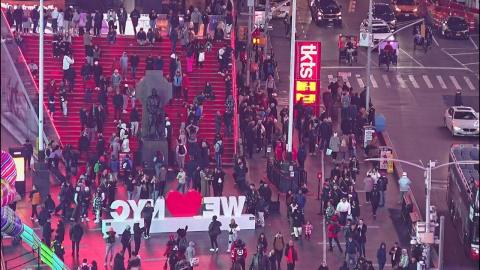
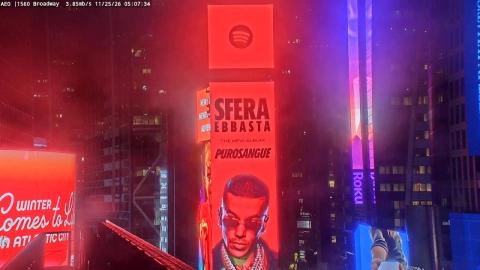
This camera sits on the American Eagle building at 1560 Broadway, on the north side of Times Square, and turns slowly between a few framings. The best of them looks straight down on Duffy Square: the glowing red staircase above the TKTS booth, people sitting on its steps or posing for photos, a bronze statue on its pedestal and the gray plaza filled with walkers and booths, all hemmed in by video screens. Other framings look down the canyon of the square between the towers or close in on the neighboring buildings and their billboards.
It is the view for the size of the crowd at street level and for the screens. Afternoons and evenings are the busiest; at night the steps and signs light up.
From Longacre Square to the Crossroads of the World
Until 1904 this was Longacre Square, a district of carriage makers and stables. That year The New York Times moved into its new tower at the south end, now One Times Square, and the city renamed the square after the newspaper. Theaters followed, and with them the electric signs that earned Broadway the name the Great White Way. The ball drop began on the last night of 1907 and still draws crowds every New Year's Eve. Since 2009 Broadway through the bowtie has been closed to cars and turned into pedestrian plazas, while Seventh Avenue still carries traffic. The northern triangle, Duffy Square, holds the statue of Father Francis Duffy, a chaplain of the First World War, and the TKTS booth, where people line up for same-day theater tickets and sit on its glowing red steps.
When to watch Times Square
New York keeps Eastern Time, UTC−5 in winter and UTC−4 from March to early November. The sun rises between about 5:25 a.m. in mid-June and 7:25 a.m. at the end of October, and sets between about 4:30 p.m. in early December and 8:30 p.m. in late June. Times Square is never empty, but it is busiest on weekend evenings and when the Broadway audiences arrive and leave. The screens look their best after dark, when they light the whole square. On New Year's Eve the plazas are closed off and filled from the afternoon on.
Around Times Square
Bryant Park and the New York Public Library are one long block east along 42nd Street, and Grand Central Terminal is a short walk farther. Rockefeller Center lies to the northeast, and the Broadway theaters line the side streets from 41st to 54th. For the skyline, Central Park, the rivers and the rest of the city, see the cams of New York City.
Visiting Times Square
The Times Square–42nd Street subway station is served by more lines than almost any other in the city, and the Port Authority Bus Terminal is a block west. Driving is not a good idea: traffic is slow and parking scarce. The costumed characters who pose for photos expect a tip, so agree on it first or decline politely.