What the Sandy Hook live cams show
Sandy Hook and the New York skyline from Highlands
This camera stands on the bluff of Highlands, on the mainland just south of Sandy Hook, and looks across the water to the peninsula. In the foreground are rooftops, autumn trees and a small marina with sailboats and larger boats; then a broad stretch of calm water, and beyond it the low, green line of Sandy Hook, with its beach, dunes and an old lookout tower. On the far horizon, faint in the haze, rises the skyline of New York.
On clear days the city stands out sharply, and the camera is good for watching boats and the weather moving in from the harbor. Afternoon light is the most even.
An osprey nest on Sandy Hook, with the bay behind
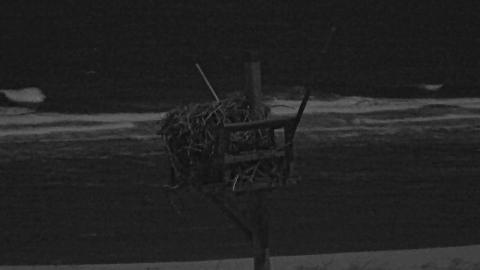
The Sandy Hook Foundation streams this close-up view of an osprey nesting platform on the peninsula, a wooden box on a tall post filled with a thick mat of sticks. Behind it lies open bay water, and at the bottom of the picture is a strip of beach and dune grass.
Ospreys come back to Sandy Hook in early spring, rebuild their nests and raise their chicks through the summer, so from spring to late summer the platform is busy with adults bringing fish and young birds testing their wings. In fall and winter the nest stays empty and the camera becomes a quiet view of the water. Mornings and early evenings are when the birds are most active.
A lighthouse, a fort and the harbor gate
The Hook is a barrier spit about six miles long and from a few hundred feet to a mile wide, built by sand carried north along the coast. Most of it is part of Gateway National Recreation Area, run by the National Park Service. Its lighthouse, first lit in 1764, is the oldest working lighthouse in the United States. For much of the 20th century the Army guarded the harbor from here: Fort Hancock, with its row of yellow-brick officers' houses, and the batteries and lookout towers along the beach date from that time. Today the ocean side is a chain of public beaches, and the bay side is a place for fishing, kayaking and birdwatching, with ospreys nesting on platforms around the salt marshes. Across the water to the north rises the skyline of New York.
When to watch Sandy Hook
Sandy Hook keeps Eastern Time, like New York: UTC−5 in winter and UTC−4 in summer. The sun rises over the ocean between about 5:25 a.m. in June and 7:20 a.m. in early January, and sets over Sandy Hook Bay between about 4:30 p.m. in early December and 8:30 p.m. in late June. Clear, dry days after a cold front give the sharpest view of the city. Ospreys are on their nests from spring to late summer. The ocean is around 40 °F in winter and in the low 70s °F in August.
Around Sandy Hook
Highlands, at the foot of the Hook, has seafood restaurants on the water and, on its hilltop, the Navesink Twin Lights. South along the coast are Sea Bright and Long Branch, and about 20 miles south is Asbury Park.
Visiting Sandy Hook
The only road onto the Hook crosses the bridge from Highlands; Newark Liberty International Airport (EWR) is about 40 miles away. Beaches fill early on summer weekends, and the park may close the entrance when its lots are full. Swim at the guarded beaches, as currents near the tip of the Hook are strong.