What the Islamorada live cams show
Hand-feeding giant tarpon on Lower Matecumbe Key
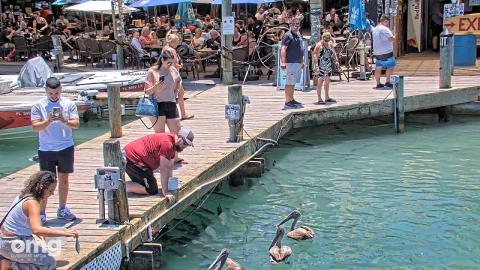
Robbie's, a marina on Lower Matecumbe Key, is where Islamorada's tarpon come to be fed by hand, and this camera watches from just above the action. People kneel at the edge with buckets of bait while the long, dark shapes of the tarpon crowd the green water below, and brown pelicans paddle in close, hoping to steal a fish. Behind the dock, diners sit under umbrellas at the open-air restaurant. There is something to watch through most of the day; around midday the sun reaches deepest into the water and the fish are easiest to see.
Islamorada's sportfishing fleet, tied up at the dock
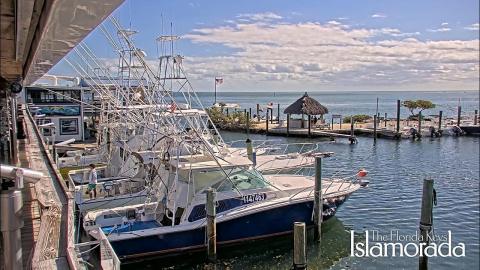
Looking down the side of a waterfront building, this tourism-council camera follows a dock lined with sportfishing boats, their outriggers and tuna towers stacked one behind the other. In the middle distance a thatched hut stands on a small pier with flags flying, and beyond it open water runs to the horizon. This is the fleet behind Islamorada's sportfishing reputation: the boats leave early with their crews and return later in the day, and the flags show the wind before a day on the water.
A bay-side marina and the mangrove keys of Florida Bay
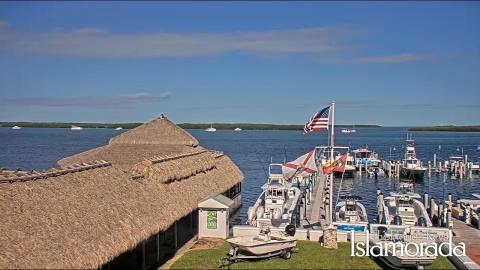
Little Basin is a small bay on the Gulf side of Upper Matecumbe Key, in the heart of Islamorada, and this tourism-council camera looks over it from above a marina. A huge thatched roof fills the left of the frame; in front, center-console fishing boats sit at the dock beneath a flagpole flying the U.S. and Florida flags, and beyond them calm water, anchored boats and a line of low mangrove islands stretch across the horizon. The flags make it a good camera for reading the wind, and in late afternoon the light on the bay turns soft and warm.
Tarpon up close, under the feeding dock
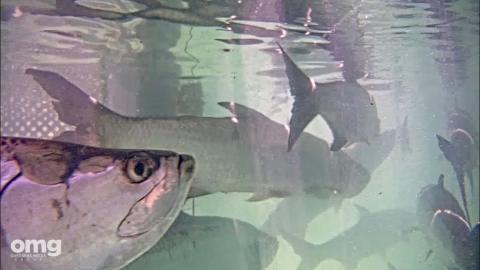
Below the waterline at Robbie's, a second camera sits beside the feeding dock, so the tarpon swim right up to the lens. Their big scales, upturned mouths and large eyes are easy to make out, and when bait hits the surface the whole school turns and rises at once. The water is clearest on bright, calm days; after strong wind or heavy rain it turns milky and the fish become shadows. Watch it alongside the dock camera above to see both sides of the same moment.
The sportfishing capital of the world
Islamorada sits between the Atlantic and the Gulf, right on the routes that big game fish follow, and it is informally known as the Sportfishing Capital of the World. The baseball great Ted Williams came here to fish from 1943 on and was the village's best-known resident for about 45 years. The most famous fish in town, though, are the tarpon at Robbie's on Lower Matecumbe Key. In 1976 the marina's owner nursed an injured tarpon back to health, and more and more tarpon began gathering at the dock to be fed; today visitors hand them bait from buckets, and two cams follow the scene above and below the surface. Islamorada was also hit almost head-on by the Labor Day Hurricane of 1935, which killed 423 people; a memorial holding the ashes of more than 300 of them stands beside the Overseas Highway at mile marker 82. The village was incorporated in 1997, and its name comes from the Spanish isla morada.
When to watch Islamorada
Islamorada sets its clocks to Eastern Time, which is UTC−4 during daylight saving and UTC−5 in winter. The charter docks are busiest early in the day, when the boats head out, and again when they come back. The tarpon are fed through the day, and the underwater cam is clearest on bright, calm days. Little Basin, on the bay side, is at its best in the soft light of late afternoon. Winter and spring are the driest months; from June to November the hurricane season brings the risk of storms.
Around Islamorada
The History of Diving Museum, opened in 2005, covers the long story of diving, including the USS Spiegel Grove, a Navy ship sunk off Key Largo to make an artificial reef. Betsy the Lobster, a giant lobster sculpture, is one of the village's landmarks. John Pennekamp Coral Reef State Park, the first underwater park in the United States, is about 19 nautical miles to the northeast on Key Largo.
Visiting Islamorada
U.S. 1 runs the length of the village: Miami is about 74 miles north and Key West about 80 miles southwest. There is no airport, so most people fly into Miami and drive. Addresses go by mile marker, so note the number before you set out. Robbie's dock, the charter marinas and the bay-side restaurants on the cams all sit just off the highway.