What the Miami Beach live cams show
A day at the south end of South Beach, in time-lapse
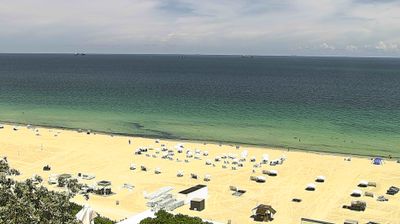
The Greater Miami Convention & Visitors Bureau keeps this camera on the Hilton Bentley, a hotel at 1st Street, a block from South Pointe Park. What plays here is not a live stream: Windy saves a picture every few minutes and strings the last 24 hours into a time-lapse that ends on the latest image. Treetops fill the lower left corner; beyond them spreads the beach, with rows of white umbrellas and loungers, then a band of pale green shallows, the line of the surf and the deep blue Atlantic out to the horizon. Start the replay before dawn to watch the sun come up over the ocean and the sand fill through the morning, then jump to the end to see the beach as it is now.
Mid-Beach from the Eden Roc, replayed over 24 hours
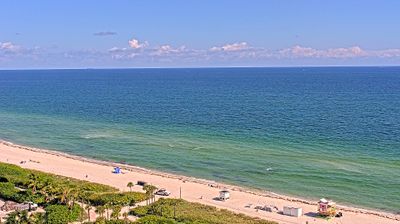
High on the Eden Roc, the resort that Morris Lapidus designed on Collins Avenue in the mid-1950s, the Greater Miami Convention & Visitors Bureau has a camera looking over the beach at 45th Street. Like its partner in South Beach, it reaches this page as a Windy time-lapse of the last 24 hours, built from pictures taken a few minutes apart. Below runs a green strip of dune with palms; then comes a wide band of sand dotted with umbrellas and cabanas, the white line of the surf and water shading from pale green to deep blue. There are fewer people here than at 1st Street, which makes it a clear view of the sea itself: how far the waves wash up the sand, and whether the surface is glassy or choppy.
From sandbar to South Beach
A century ago, most of this island was a sandbar matted with mangroves and jungle. Dredging and filling stretched it from about 1,600 to 2,800 acres after the Collins Bridge reached it from the mainland in 1913, and the town was chartered in 1915. South Beach, the stretch from South Pointe up to about 23rd Street, holds the Art Deco Historic District, listed on the National Register of Historic Places in 1979: hundreds of hotels and apartment buildings put up between 1923 and 1943, the largest collection of Art Deco architecture anywhere. The playful lifeguard stands on the sand came later, after Hurricane Andrew in 1992, when architect William Lane donated new designs to the city. Mid-Beach belongs to the next era: on Collins Avenue, Morris Lapidus designed the Fontainebleau, opened in 1954, and the Eden Roc next door soon after.
When to watch Miami Beach
Both cams face the ocean, so sunrise is the moment to replay: the sky lightens over the Atlantic, then the first umbrellas go up. Miami Beach runs on Eastern Time, five hours behind UTC in winter and four from March to early November. The dry season, roughly November to April, brings sunshine, lower humidity and the fullest beaches. From May to October showers and late-day thunderstorms are common, and the time-lapse shows them sweeping in and clearing out. Hurricane season runs from June through November.
Around Miami Beach
South Pointe Park, at the very tip of the island, looks across Government Cut, the shipping channel dug in 1905 that carries ships to and from PortMiami. Ocean Drive and its Art Deco hotels start a few blocks north, and Lincoln Road, largely closed to cars between 16th and 17th streets, makes an easy evening stroll. Beyond Mid-Beach, Collins Avenue carries on through North Beach toward Surfside and Bal Harbour.
Visiting Miami Beach
Several causeways link the islands to Miami, and Miami International Airport lies on the mainland to the west. City trolley routes connect South Beach with Mid-Beach and North Beach. On the sand, swim near a staffed lifeguard stand and read the flags: Florida beaches use the same colors statewide, with yellow for moderate surf or currents and red for high hazard.