
What the Timberline Lodge live cams show
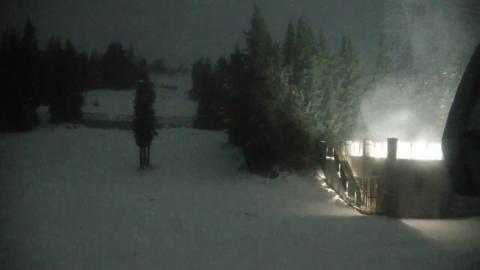
The historic lodge in the snow, from its parking lot
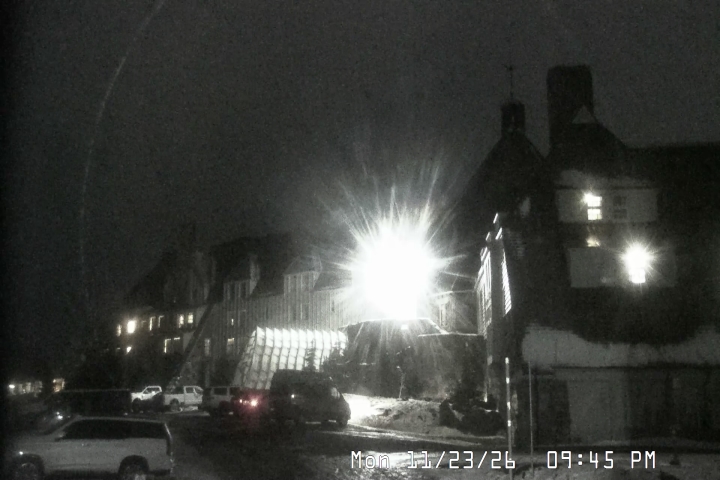
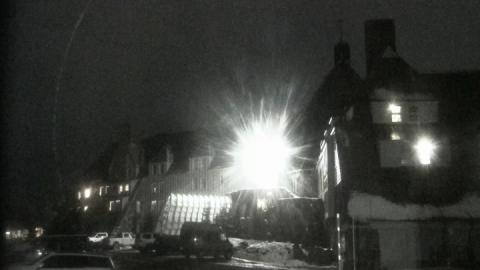
Timberline's lodge camera looks across the upper parking lot at the building itself: the steep roofs and dormers, the great stone chimney of the central head house and, on stormy days, snow piled to the windowsills. Cars, plows and loaders work in the lot in front of the entrance.
This is the National Historic Landmark built by the Works Progress Administration in the 1930s, whose exterior stood in for the hotel in the film The Shining. The camera is the quickest way to see how much snow has fallen at 6,000 feet and whether the lot has been cleared. It is a still image, not a video: the reload button brings the latest one.
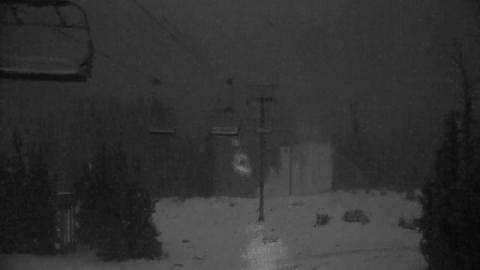
Chairs passing over a lift station among the firs
Named for the Magic Mile on Timberline's cam page, this camera looks up at chairs passing overhead and a gray lift building half buried among snow-covered firs. The Magic Mile was the first chairlift on the mountain, opened in 1939 and at the time the longest in the world; today it climbs above the lodge toward Silcox Hut, the old warming hut about a thousand vertical feet higher.
It is a close view rather than a panorama, good for judging how much snow has stuck to the trees, the cables and the roof, and whether the lift is turning.
Chairs dropping into Still Creek Basin below the lodge
This camera stands by the Jeff Flood Express, the high-speed quad that opened for the 2007–08 season and added the Still Creek Basin to Timberline's terrain, below the lodge. A chair hangs close in front of the lens, and the line of towers runs away into a forest of snow-plastered firs, with a lift structure and open snow at the top of the slope.
Because this terrain lies below the lodge, it is the camera to check whether the lower mountain has enough snow, and how low the cloud has come on a stormy day.
A wide run and snow-loaded firs below the lodge
The Pucci camera looks up a wide run between stands of firs, their branches bent under the snow, with a lift building at the right edge and a service road in the foreground where resort vehicles park. Pucci is one of Timberline's chairlifts, and the camera takes its name.
It shows the snow on the trees and the run, whether the grooming machines have been through and how far down the clouds reach. Like the other Timberline cams, it sends still images rather than video.
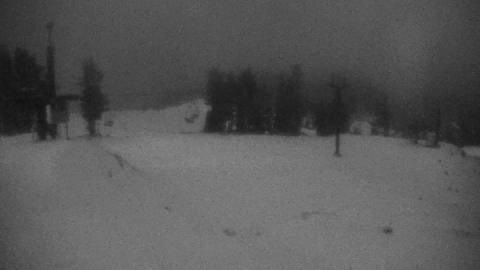
Timberline's beginner slope by the lodge
This camera looks across the top of Bruno's, the beginner chairlift near the lodge, over a broad open slope of snow with a lift tower at the right and a few wind-bent trees on the skyline.
It is the easiest of the Timberline cams to read: a smooth white slope means fresh snow and grooming, fog at the edges means cloud on the lodge area, and in summer the bare ground shows how far the snow has retreated up the mountain.
Toward the Palmer snowfield, near Silcox Hut
The highest of Timberline's cams sits near the bottom of the Palmer chairlift, by Silcox Hut at about 7,000 feet, on the open slopes where trees give way to snow and rock. The Palmer lift climbs from here onto the snowfield that lets Timberline offer skiing in every month of the year.
Up here the weather changes fast: on clear days the view opens across the upper mountain, and in storms or cloud the frame turns completely white, a sign of whiteout conditions on the upper lifts.
A WPA lodge on a volcano
Timberline Lodge was built between 1936 and 1938 by the Works Progress Administration, with local craftsmen carving its timbers and furnishings, and President Franklin D. Roosevelt dedicated it on September 28, 1937. Its ground floor is rubble masonry of boulders from the mountain, and the central hexagonal head house has a stone chimney 90 feet tall; the building is a National Historic Landmark, and its exterior played the Overlook Hotel in the film The Shining. The Magic Mile chairlift opened in 1939, at the time the longest chairlift in the world, and since the Palmer lift opened the snowfield above 7,000 feet, skiers have been able to ride a lift here in every month of the year. Unusually, most of the ski terrain lies below the lodge, down into Still Creek Basin, served since 2007 by the Jeff Flood Express.
When to watch Timberline Lodge
Timberline keeps Pacific Time, UTC−8 in winter and UTC−7 from March to early November. The sun rises between about 5:20 a.m. in mid-June and 7:45 a.m. at the start of January, and sets between about 4:25 p.m. in mid-December and 9 p.m. in late June. From late fall, storms bury the lodge in snow, and the cams show whether the parking lot is plowed and whether the upper lifts are in cloud: the higher the camera, the sooner it vanishes when the clouds come down. In summer the snowfield above the lodge fills with ski and snowboard camps.
Around Timberline Lodge
The summit of Mount Hood, 11,249 feet, rises about three miles north of the lodge, and climbers set out from here on the south side route. The Pacific Crest Trail passes right by the lodge on its way around the mountain. Six miles down the road, Government Camp has the village, the small Summit Pass ski area and Mt. Hood Skibowl, whose cams are on its page.
Visiting Timberline Lodge
From Portland, U.S. 26 climbs east to Government Camp, and the Timberline Highway leaves it just east of the village for the six-mile climb to the lodge. In winter, carry chains: they or traction tires are often required on U.S. 26 and the road to the lodge, and a Sno-Park permit is needed to park at many winter recreation areas around Mount Hood. Portland International is the nearest major airport.