What the Solitude live cams show
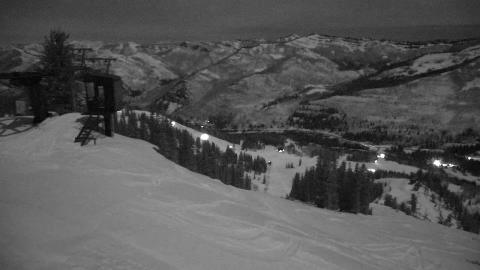
Big Cottonwood Canyon from the top of Powderhorn
Solitude Mountain Resort streams this camera from the top of the Powderhorn lift on Eagle Ridge, beside the lift's upper terminal. It looks down the slope and the forested runs to the floor of Big Cottonwood Canyon, with the road and the base area far below, and across to the long ridges on the other side.
It is the widest view of the resort, good for the snow line on the canyon walls, the cover on the runs and the clouds over the Wasatch. Clear mornings after a storm show the whole canyon white.
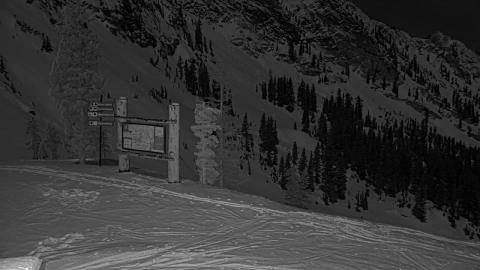
The limestone walls of Honeycomb Canyon
At the head of Honeycomb Canyon, the back bowl of Solitude reached by the Summit Express lift, this camera stands beside an orange-framed trail map and a sign. It looks across the bowl to its pale limestone cliffs and the spruce-covered slopes below them.
Honeycomb holds Solitude's bowl skiing, so this is the camera to watch for natural snow: the first storms dust the cliffs and the open slopes, and in midwinter the bowl fills in.
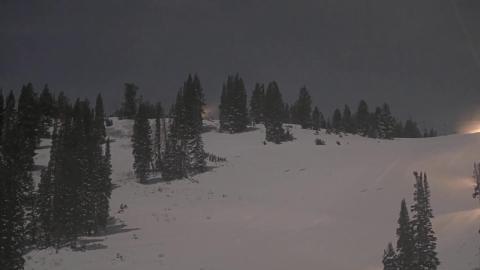
The open slope of Sunshine Bowl
This Solitude camera looks up Sunshine Bowl, a wide, open slope with scattered spruces and a line of lift towers along the crest at the top. In fall it is dry, golden grass; after the first storms it turns white from top to bottom.
Use it to judge the snow cover on the open terrain and the wind on the crest, where blowing snow shows against the sky.
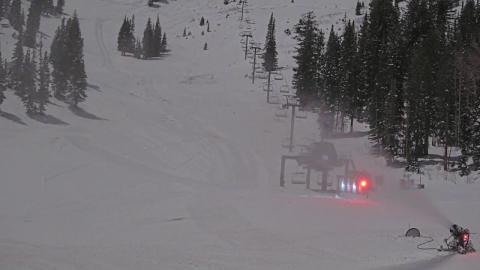
The bottom of the Powderhorn II lift
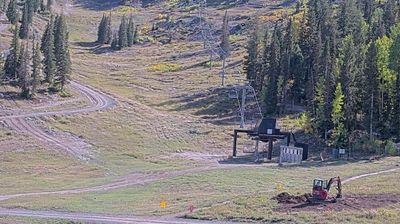
Solitude streams this view of the bottom station of the Powderhorn II lift, one of the two lifts that climb to Eagle Ridge. The loading area and the lift's drive terminal stand in a clearing, and the lift line runs up the slope through stands of spruce and aspen, past a winding service road.
In season it shows the line at the lift and the grooming on the runs below; in fall, the bare ground and the first snow in the shadows.
Moonbeam lift in the Solitude base village
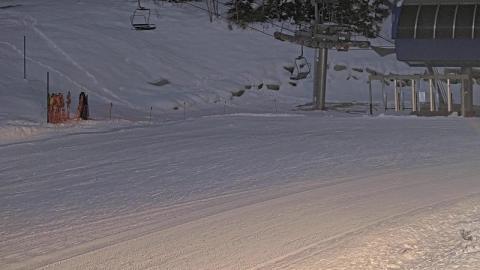
This Solitude camera sits at the Moonbeam lift in the base village, the lift that serves the beginner terrain. In front is the gravel loading area, beside the blue cover of the bottom terminal and a stone wall; chairs swing past on the cable to the left.
Use it to see the snow and the people at the base, where the day starts for most visitors.
A day at the Powderhorn II lift
Windy serves this time-lapse of Solitude's Powderhorn II camera, replaying the last 24 hours at the bottom of the lift. It shows the shadows moving across the lift line, grooming at night in season and how much snow fell since the day before. It is the same view as the live Powderhorn II camera, condensed into a few seconds, and handy when the canyon is dark or in cloud.
A resort born of a closed door
Solitude was started by Robert M. Barrett, a uranium prospector from Moab who, the story goes, was refused the use of the restrooms at Alta, which were kept for its guests, and decided to build his own ski area in the next canyon. He began in 1956 and opened a year later. Gary DeSeelhorst bought the resort in 1977 and in 1989 built Utah's first high-speed quad chairlift, the Eagle Express. Deer Valley took it over in 2015, and Alterra Mountain Company has owned it since 2018. The mountain has about 1,200 acres and 66 runs with a vertical drop of about 2,050 feet. Most trails come down from Eagle Ridge, along the canyon road; behind the ridge, Honeycomb Canyon holds the bowl skiing, reached by the Summit Express lift.
When to watch Solitude
Solitude keeps Mountain Time, UTC−7 in winter and UTC−6 from March to early November. The sun rises between about 5:55 a.m. in mid-June and 7:55 a.m. at the end of October, and sets between about 5:00 p.m. in early December and 9:00 p.m. in late June. The season usually runs from late November into April. Storms off the Great Salt Lake bring deep, dry snow; a clear morning after one shows Honeycomb Canyon and the canyon walls at their best. In summer the cams show green slopes and wildflowers.
Around Solitude
Brighton, the other ski area of Big Cottonwood Canyon, is about 2 miles up the road, and the two share a joint pass. Over the ridge to the south, in Little Cottonwood Canyon, are Snowbird and Alta, and Park City and Deer Valley lie on the far side of the Wasatch crest. Down the canyon, Utah 190 leads to the Salt Lake Valley.
Visiting Solitude
Solitude is reached by Utah 190, the Big Cottonwood Canyon Scenic Byway, about 14 miles up the canyon from its mouth; the road can close for avalanche control after storms, and traction rules apply in winter. Utah Transit Authority ski buses run up the canyon. Salt Lake City International is the nearest airport. A small village with lodging and restaurants sits at the base, by the Moonbeam lift.