What the Snowbird live cams show
A 360° turn from the summit of Hidden Peak
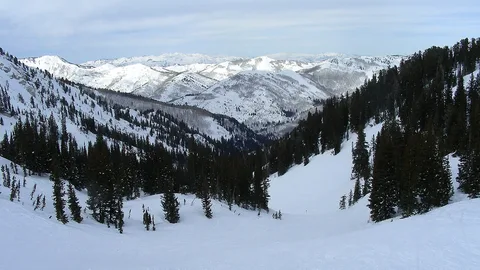
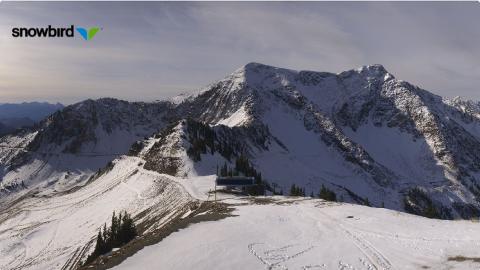
Snowbird's panorama camera sits on Hidden Peak, at about 11,000 feet the top of the resort and of its aerial tram, and turns slowly through a full circle. Along the way it shows snowy summits of the Wasatch, the top of a chairlift, the long rocky ridges that drop toward the Salt Lake Valley and, on clear days, the valley itself far below.
Because it keeps turning, each view lasts only a moment; let it run to see the whole circle. Use it for new snow on the peaks, the wind on the summit and the visibility before taking the tram up. Clear mornings after a storm are the most spectacular.
Up Peruvian Gulch from the Cliff Lodge
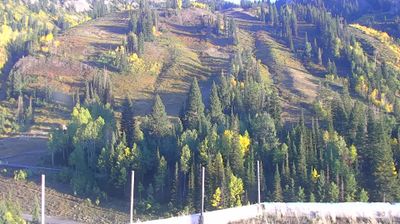
Windy serves this time-lapse from Snowbird's Cliff Lodge camera, which looks up Peruvian Gulch, the valley that climbs from the base area toward Hidden Peak. In front stand avalanche fences and a low concrete wall; behind them aspens and spruces grow on steep slopes that are brown in fall and white from the first big storm.
The 24-hour replay shows the light moving across the gulch and the snow line creeping down toward the base as winter comes.
Little Cloud and the upper slopes of Gad Valley
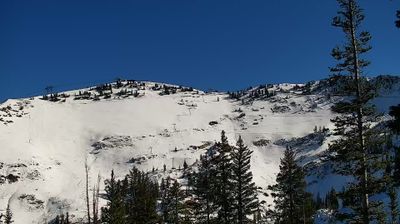
Windy serves this time-lapse of Snowbird's Little Cloud camera, which looks across Gad Valley to the open upper slopes below Hidden Peak, with lift towers and a summit building on the ridge and spruces in the foreground. The 24-hour replay shows the sun moving over the bowl, clouds dropping onto the ridge and any new snow from the night before.
Snowbird's own player for this camera only works on its website, so Windy's replay is the way to watch it here.
A resort in a silver canyon
Little Cottonwood Canyon was mining country first: silver was found here in 1869, and the Emma Mine made the canyon one of the richest in the Wasatch, with thousands of people living along it until avalanches destroyed the camps. Snowbird came much later. Ted Johnson, who had run the Alta Lodge up the canyon, explored the terrain of Peruvian Gulch and Gad Valley, and with the Texas oilman Dick Bass he opened Snowbird in December 1971. Its aerial tram climbs from the base to Hidden Peak, at 10,992 feet the highest point of the resort, and a 600-foot tunnel with a conveyor lift links Peruvian Gulch with Mineral Basin on the back side. The resort covers about 2,500 acres with a vertical drop of 3,240 feet.
When to watch Snowbird
Snowbird keeps Mountain Time, UTC−7 in winter and UTC−6 from March to early November. The sun rises between about 5:55 a.m. in mid-June and 7:55 a.m. at the end of October, and sets between about 5:00 p.m. in early December and 9:00 p.m. in late June. Snowbird and Alta usually get more than 500 inches of snow a year, enhanced by the Great Salt Lake, and the season on the upper mountain often lasts until Memorial Day, sometimes into summer. Watch the Hidden Peak panorama on a clear morning after a storm, when the peaks of the Wasatch stand out against a blue sky.
Around Snowbird
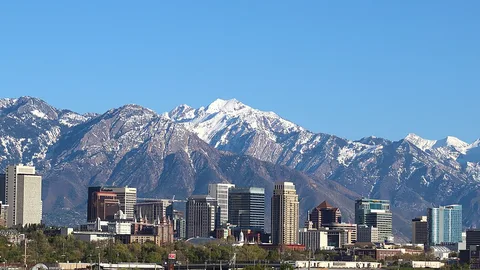
Alta, open since 1938 and still closed to snowboarders, lies just up the canyon, and the two resorts share terrain on a joint ticket. Down the canyon, Utah 210 leads to the Salt Lake Valley and Salt Lake City. In the next canyon to the north, Big Cottonwood, are Solitude and Brighton; Park City lies on the other side of the Wasatch crest.
Visiting Snowbird
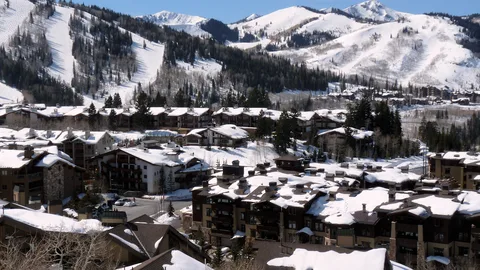
Snowbird is reached by Utah 210 up Little Cottonwood Canyon, a road prone to avalanche closures and heavy traffic on powder days; buses of the Utah Transit Authority run up the canyon in winter. Salt Lake City International is the nearest airport, about an hour away. The resort has its own lodges, among them the Cliff Lodge, at the base.