What the San Simeon live cams show
Dozens of young seals on the sand at the Piedras Blancas rookery
California State Parks streams this camera on the south beach of the rookery. It looks along a wide stretch of dark sand strewn with driftwood: a low, brush-covered bluff rises on the left, a rocky reef edged with white surf runs across the back, and the open Pacific fills the horizon. Elephant seals lie in loose rows near the bluff and along the high-tide line, a few propped up on their front flippers. In October the beach holds dozens of young seals resting during the fall haul-out; from December to March it fills with bulls, mothers and newborn pups. On warm days, watch them flip sand over their backs to keep cool.
Kelp, rocks and the visitors' boardwalk above the seal beach
Also run by California State Parks, this camera looks across a smaller beach at the north end of the colony, back toward land. Rocks and piles of kelp mark the waterline in front, where small shorebirds feed between the waves; behind the sand a low bluff is covered in brush, and along its top runs the wooden boardwalk where people stop to watch the seals, with the parking area beyond. Outside the busy months the sand can be almost empty. From December to March the seals pack this beach too, and with the visitors in the same picture, it is easy to judge how big the animals really are.
Point Piedras Blancas and its truncated tower, often in fog
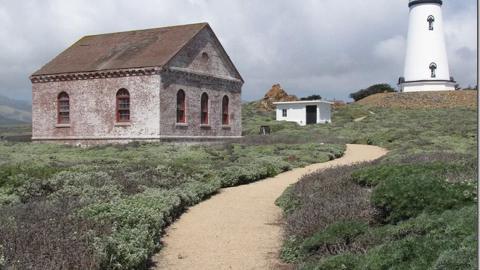
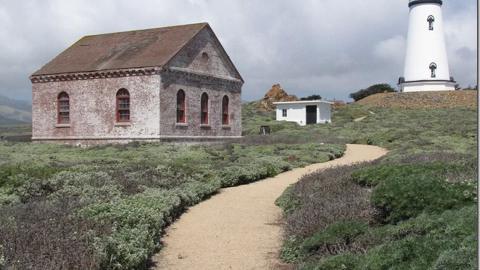
California State Parks aims this camera down the shore toward Point Piedras Blancas. With the open sea on the right, the view runs from a gray beach and the surf in the foreground, past a row of dark rocks, to the low point where the light station's tower stands among its outbuildings. The tower looks short and flat-topped for a lighthouse because its lantern and upper floors were taken off after a 1948 earthquake. Fog rolls over this point often, especially in summer, and in thick weather the tower fades to a pale outline; on clear days it stands out sharp against the sky. The station grounds are managed as a wildlife sanctuary, and the waters off the point form a state marine reserve.
The elephant seals of Piedras Blancas
Hunted for the oil in their blubber, northern elephant seals fell to a few dozen animals by the end of the 19th century; protected since the early 20th, they have recovered to more than 200,000. Seals began using this shore in 1990 and the first pup was born here in 1992; the colony is now one of the largest on the Pacific coast. Bulls reach about 16 feet and more than 5,000 pounds. Adult males arrive at the end of November and battle for space; most pups are born from late December to late January and nurse for about four weeks before their mothers head back to sea. Females and young seals return to molt in spring, peaking around May, the bulls molt in summer, and juveniles crowd the sand again in the fall haul-out, which peaks in late October.
Piedras Blancas Light Station
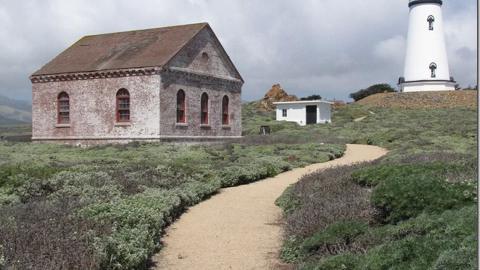
Piedras Blancas is Spanish for "white rocks." The light was first lit here in 1875; after an earthquake at the end of 1948, the top three levels, lantern included, were removed, leaving a squat tower about 70 feet tall. The Bureau of Land Management looks after the station and shows it on guided tours.
When to watch San Simeon
Times here are Pacific: UTC−8 in winter, UTC−7 during daylight saving time, March to early November. The seal cams are liveliest from December to March, during births and mating. Summer fog often turns the lighthouse into a gray outline; clear winter afternoons give the sharpest pictures. The shortest days end with sunset near 4:55 p.m. in early December, the longest near 8:25 p.m. in late June.
Around San Simeon
Hearst Castle, given to California by the Hearst family in 1958, crowns a hill a few miles southeast of the rookery. In the old village, William Randolph Hearst Memorial State Beach has a pier and the Coastal Discovery Center. North of Piedras Blancas, Highway 1 heads into Big Sur.
Visiting San Simeon
The main viewing area is a roadside parking lot and boardwalk off Highway 1, where volunteer docents from Friends of the Elephant Seal are often on hand. Stay on the boardwalk and behind the fences: elephant seals move fast over short distances, and federal guidelines call for a distance of at least 50 yards. The closest scheduled flights are at San Luis Obispo County Regional Airport (SBP), about 45 miles southeast. Landslides have closed Highway 1 through Big Sur for long periods, so check Caltrans before driving north.