What the Rowe Sanctuary live cams show
The braided Platte River and its sandbars at Rowe
Platte Basin Timelapse, a University of Nebraska–Lincoln project, mounted this camera on an observation tower at Audubon's Rowe Sanctuary, looking over the Platte at one of its crane roosts. The river spreads out in front in a maze of shallow channels and low, bare sandbars, with dry grass and brush on the near bank, the corner of a roof at the lower right and a line of trees along the far shore.
This is the water where sandhill cranes stand overnight in March, and around sunrise and sunset in crane season the sandbars fill with birds. The rest of the year it shows the river rising and falling, ice in winter and the changing light.
The Platte at dawn from the Rowe Sanctuary crane cam
explore.org streams this crane cam with Audubon at Rowe Sanctuary, on the Platte River near Gibbon. It is a moving camera that changes its view through the day: one moment it faces the sunrise over a dark band of wet meadow and a line of cottonwoods, the next it looks across the river's shallow channels and sandbars toward a power line and the trees of the far bank.
It is the camera for the cranes' dawn liftoff and evening return in March and early April, and for big Nebraska sunrises and sunsets over the river the rest of the year.
The great crane gathering
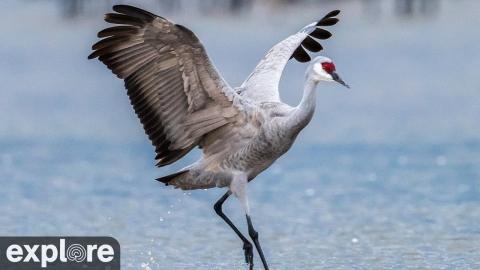
Each spring, hundreds of thousands of sandhill cranes stop on the central Platte on their way north to nesting grounds in Canada, Alaska and Siberia. They come for the river's broad, braided channels, where they stand on sandbars in shallow water at night, safe from predators, and for the corn stubble on the farms around it, where they feed and fatten during the day. At the height of the season the five-mile stretch of river at Rowe can hold up to about 200,000 cranes. Audubon set aside the sanctuary in the 1970s and manages about 3,000 acres of river channel, wet meadow and grassland, clearing brush from the sandbars so the river stays open the way the cranes need it. The visitor center is the Iain Nicolson Audubon Center.
When to watch the crane cam
The migration usually begins in early March and lasts four to six weeks, until early or mid April. The two moments to watch are sunrise, when tens of thousands of cranes rise off the river together, and sunset, when they come back in long lines to land on the sandbars, calling all the while. Rowe keeps Central Time, UTC−6 in winter and UTC−5 from March to early November; in mid-March the sun rises around 7:45 a.m. and sets around 7:40 p.m. Outside crane season the camera stays on the Platte through the year, with the wildlife that comes to the river, ice and snow on the sandbars in winter and the water rising and falling with the seasons.
Around Rowe Sanctuary
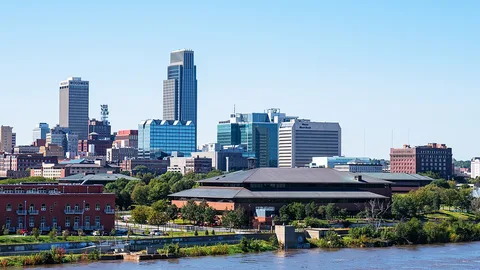
Kearney, about 15 miles west, grew up near Fort Kearny, a stop on the Oregon Trail, and the Great Platte River Road Archway spans Interstate 80 east of town with a museum of the trails west. Grand Island lies about 30 miles east. Omaha, on the Missouri River, is about three hours east, and the Platte flows on to join the Missouri south of the city.
Visiting Rowe Sanctuary
The sanctuary is south of Interstate 80 near Gibbon. In crane season it offers guided visits to viewing blinds on the river at dawn and dusk, booked in advance, and the trails and the visitor center are open through the year. Kearney Regional Airport (EAR) and Central Nebraska Regional Airport (GRI) in Grand Island are the closest airports, and Omaha's Eppley Airfield (OMA) is about 180 miles east. Cranes are easily disturbed on their roosts, so visitors watch them from blinds and viewing platforms, not from the river banks.