What the Purgatory live cams show
Snowy peaks of the San Juans from Paradise
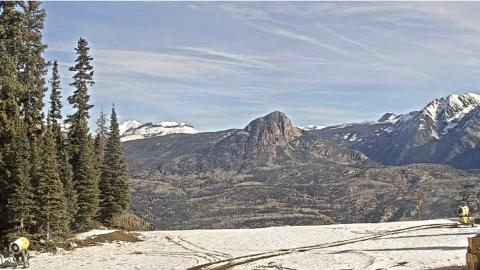
Purgatory Resort streams this camera from Paradise, an area high on the mountain, looking across a slope where snow guns are building the first cover of the season. Beyond the trees the land drops into a wide valley and rises again to a lone, rocky summit, with the white peaks of the San Juan Mountains behind it.
It is the resort's best view of the high country: watch it for new snow on the peaks, clouds building over the range and the progress of the snowmaking on the slope. Clear mornings after a storm are the sharpest.
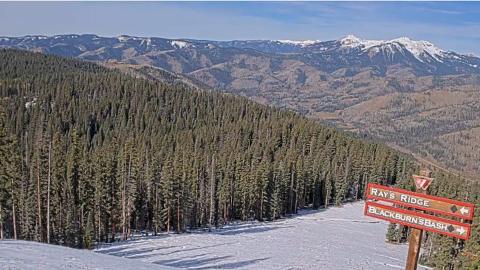
The view from the top of Ray's Ridge
This Purgatory Resort camera stands by the trail signs at the top of Ray's Ridge, named after Ray Duncan, one of the founders, where the runs split toward Blackburn's Bash and the rest of the mountain. The groomed run drops through dense forest, and across the valley a long range of snowy summits fills the skyline.
Use it to see the snow on the upper runs and the weather over the San Juans. The sign and the run in the foreground make it easy to judge how deep new snow is.
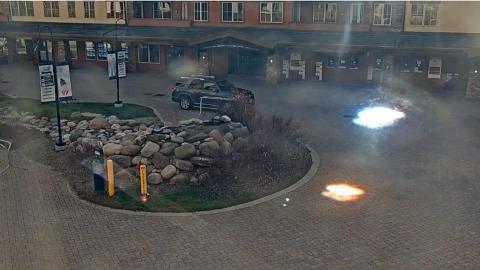
The plaza of Purgatory's base village
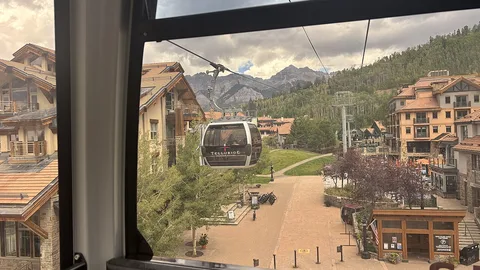
Purgatory Resort's plaza camera looks over the paved square at the center of the base village, with a stone planter and trail signs in front and the lodges, ticket windows and shops behind. A chairlift and a red building climb the slope above the roofs.
It is the camera for the crowds: on winter mornings the plaza fills with skiers walking to the lifts, and in summer with bikers and hikers. It also shows how much snow sits in the village on a storm day.
A ski area named for a creek
Purgatory opened in 1965, founded by Chet Anderson, a U.S. Forest Service ranger, and the oilman Ray Duncan; Ray's Ridge and Chet's are named after them. The resort takes its name from Purgatory Creek, which runs through the base area, and many runs follow the theme: Angel's Tread, Demon, Styx, Nirvana. From 2000 to 2015 it was called Durango Mountain Resort, until new owners restored the original name. The summit stands at 10,822 feet, with a vertical drop of about 2,030 feet over more than 1,500 skiable acres, and the mountain averages some 260 inches of snow a year. A shuttle connects the resort with Durango in winter.
When to watch Purgatory
Purgatory keeps Mountain Time, UTC−7 in winter and UTC−6 from March to early November. The sun rises between about 5:50 a.m. in mid-June and 7:35 a.m. in early January and early March, and sets between about 4:55 p.m. in early December and 8:35 p.m. in late June. The season usually runs from late November to early April. Clear mornings after a storm show the peaks at their sharpest; in summer the resort runs lifts for hiking and mountain biking, and the aspens around it turn gold in late September.
Around Purgatory
U.S. 550, the San Juan Skyway, continues north over Coal Bank and Molas passes to Silverton, the old mining town at the end of the narrow-gauge railroad from Durango. Haviland Lake and Electra Lake lie in the forest a few miles south of the resort, and the Weminuche Wilderness, the largest in Colorado, spreads east of the highway.
Visiting Purgatory
The resort is about 25 miles north of Durango, roughly 40 minutes by U.S. 550, which is plowed in winter but can be slick on its climbs. The nearest airport is Durango–La Plata County. Lodging at the base is mostly condos around the plaza; most visitors stay in Durango.