What the Ogunquit live cams show
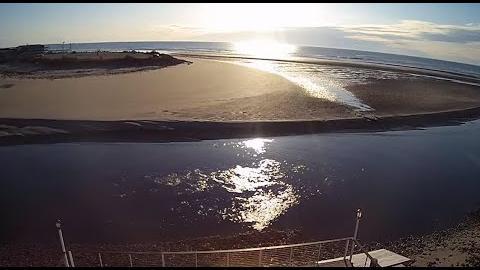
Where the Ogunquit River meets the sea
From a deck at Sea Chambers, an oceanfront inn on Shore Road, this camera looks out over the mouth of the Ogunquit River. The river curls past in the foreground, the sandy tip of Ogunquit Beach spreads out on the left, and the channel bends out to the open Atlantic between the beach and the rocky shore on the right, where the Marginal Way begins its walk along the ledges. The scene changes completely with the tide: at low water the sandbars nearly close the channel and people walk far out across them, while at high tide the river runs wide and deep up to the rocks. Mornings look into the sun, so afternoons are clearest.
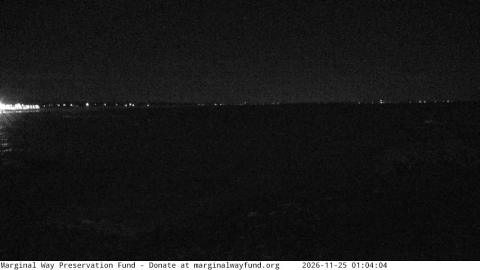
The cliff walk and the long beach, from the Marginal Way lighthouse
The Marginal Way Preservation Fund, the nonprofit that looks after Ogunquit's footpath along the rocks, keeps this camera on the small lighthouse beside the path. It moves between several views. One looks down the paved walk, past a bench and the granite ledges, to the open Atlantic; another zooms north across the water to the long sand of Ogunquit Beach, the dunes behind it and the houses of Wells in the distance. It shows how hard the sea is working against the rocks, how many walkers are out and, at low tide, the bars and pools along the beach. The morning sun shines toward the lens on the ocean view, so the beach views are sharper later in the day.
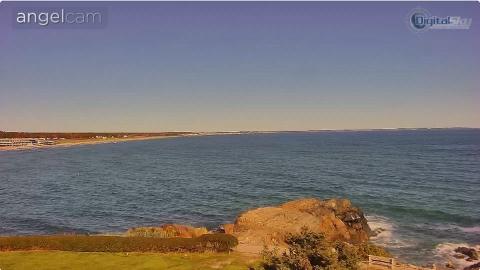
Ogunquit Beach curving north, from the Beachmere Inn lawn
Beachmere Inn sits on the bluff at the north end of the Marginal Way, and its camera looks north from the lawn. A clipped hedge and a granite outcrop, where the waves break white, fill the foreground. To the left the shore curves away into the long sand of Ogunquit Beach, more than three miles of it, with motels near the river mouth and the low line of dunes and houses running toward Wells on the horizon. It is the widest view of the beach in Ogunquit, good for judging the surf and the size of the crowd on a summer day, and at its best in late afternoon, when the low sun from the left lights the sand.
A beautiful place by the sea
The name is usually explained as an Abenaki phrase meaning "beautiful place by the sea." The village was part of Wells until 1980, when it became a town of its own. From the 1890s painters such as Charles Woodbury came here and founded one of the first art colonies on the Maine coast, and the Ogunquit Museum of American Art and the Ogunquit Playhouse, a summer theater since the 1930s, keep that tradition alive. The beach is a barrier spit of more than three miles of sand between the river and the ocean, and the Marginal Way runs for about a mile and a quarter along the ledges from Shore Road to Perkins Cove.
When to watch Ogunquit
Ogunquit keeps Eastern Time, UTC−5 in winter and UTC−4 in summer. Sunrise ranges from about 5:00 a.m. in mid-June to 7:15 a.m. in late October and early January, and sunset from about 4:05 p.m. in December to 8:25 p.m. in late June. The cameras face east, into the morning sun, so afternoons give the clearest pictures. Tides rise and fall about 9 feet: at low tide the sandbars at the river mouth spread out and the beach is at its widest, at high tide the river fills up to the rocks. The season runs from late May to Columbus Day weekend, and the water stays cool, rarely much above the mid-60s °F.
Around Ogunquit
Perkins Cove, at the south end of the Marginal Way, is a tiny fishing harbor with a pedestrian drawbridge, lobster boats and restaurants. North of the beach, Wells has more miles of sand and the Rachel Carson National Wildlife Refuge, and York, with Long Sands Beach and the Nubble lighthouse, is about 6 miles south.
Visiting Ogunquit
The village is just off U.S. Route 1, about 35 miles south of Portland International Jetport (PWM) by I-95 and about 75 miles north of Boston. Parking is limited and paid in summer, and a seasonal trolley links the village, the beach, Perkins Cove and the hotels on Route 1. The Marginal Way is paved and easy, but the rocks beside it are slippery and the sea can surge up over them in a storm: stay on the path.