What the Mount Washington Cog Railway live cams show
Waumbek, the halfway station on the Cog
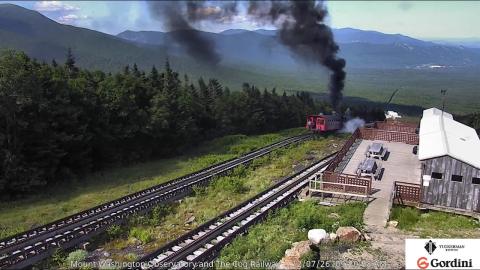
Halfway up the line, the Mount Washington Observatory keeps a camera at Waumbek, the station where trains going up and coming down can pass each other. The tracks split into a siding in front of a curved-roof shed and a weathered clapboard building with a deck, and behind them the mountainside drops away to the forests of the valley below and a long line of ridges on the horizon. Trees here are already stunted by wind and altitude. Watch for the trains pausing on the siding, and for the line where cloud meets the slope, which often sits close to this height.
Trains, old engines and the mountain at the base station
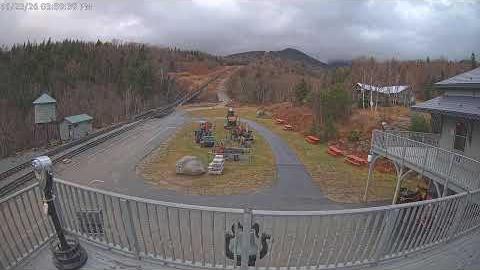
The Cog Railway's own camera looks over its base station on the western side of Mount Washington, at about 2,700 feet. From the railing of the station deck, with a bell and a pair of coin-operated binoculars in the foreground, it shows the plaza below with old locomotives on display, a passenger coach waiting on the left, the green-roofed water tower, and the track climbing away over a trestle into the woods. The summit ridge rises at the top of the picture. Trains leave from here through the operating season, the steam engines trailing dark smoke, and the camera catches each departure and return.
Up the rails toward the summit
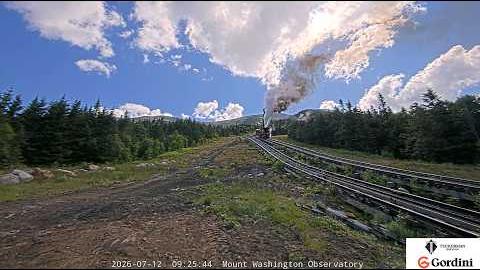
A second observatory camera beside the Cog Railway looks straight up the line toward the top of the mountain. The rack-and-pinion track runs from the bottom of the frame between stands of spruce and fir, with a gravel service road alongside, and climbs toward the bare upper slopes and the ridge on the skyline. In the morning the sun rises over the right shoulder of the mountain and shines into the lens. It is the camera for spotting trains on the climb and for seeing frost, snow or ice on the rails, which in winter keep the trains from going all the way to the top.
A railway up the steepest slope
Sylvester Marsh, a businessman who had nearly died on the mountain in a storm, spent years convincing doubters before the line opened in 1869; that same summer President Ulysses S. Grant rode it. The track is about 3 miles long, climbs from about 2,700 feet at the Marshfield Base Station to just below the summit, and has an average grade of over 25 percent. On the curved trestle called Jacob's Ladder the slope reaches 37 percent, the second steepest of any rack railway in the world. A toothed rail between the running rails engages a gear under each locomotive. Steam engines still run, burning coal and pushing a single coach uphill, alongside newer biodiesel locomotives.
When to watch the Cog
The Cog keeps Eastern Time, UTC−5 in winter and UTC−4 in summer. Sunrise ranges from about 5:00 a.m. in mid-June to 7:20 a.m. in early January, and sunset from about 4:05 p.m. in December to 8:35 p.m. in late June. Trains run from spring to fall and, in winter, partway up the mountain; the base station is busiest at midday in summer and during fall color in late September and early October. Clouds often sit on the upper line while the base is clear.
Around the Cog
The summit of Mount Washington, with its observatory and visitor center, is at the top of the line. The base station is a few miles from Bretton Woods, where the grand Mount Washington Hotel and a ski area sit at the foot of the Presidential Range, and the Ammonoosuc Ravine Trail starts nearby.
Visiting the Cog
The base station is at the end of Base Station Road, off U.S. Route 302 near Bretton Woods. A trip to the summit and back takes about three hours, including about an hour on top; reservations are recommended in summer and fall. Take warm layers even on a hot day, since the summit is often 30 degrees colder than the base and windy.