What the Logan Pass live cams show
Snow and crowds at the top of the Going-to-the-Sun Road
The Glacier National Park Conservancy keeps this camera on the visitor center at Logan Pass, the highest point of the Going-to-the-Sun Road at 6,646 feet. The edge of the building's roof fills the lower frame, and beyond it the open meadow of the pass stretches to a line of clumped subalpine firs and a long boardwalk, with the slopes around the pass rising behind.
In summer it shows how full the parking lot is, which matters, since spaces often run out by mid-morning. In spring and fall it shows the snow: the pass gets some of the deepest snowpack in the park, and the road here stays closed for most of the year.
Hidden Lake trailhead at Logan Pass
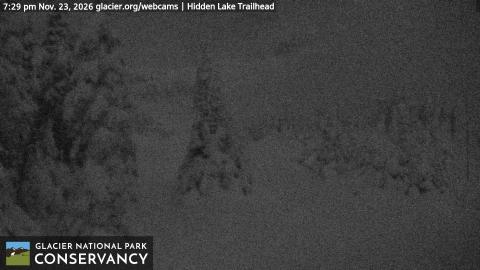
Just behind the Logan Pass visitor center, the trail to Hidden Lake heads out across an alpine meadow, and this Conservancy camera watches where it begins. Stunted firs stand in small groups among boulders, and in summer the meadow fills with wildflowers and the boardwalk carries a steady stream of hikers. The overlook above Hidden Lake is about 1.4 miles away.
Mountain goats and bighorn sheep often graze in this meadow, so the image is worth a look for wildlife. Snow lingers here into July and returns early, and on stormy days the camera shows blowing flakes long before snow reaches the valleys.
Logan Pass: Mount Reynolds and the St. Mary valley
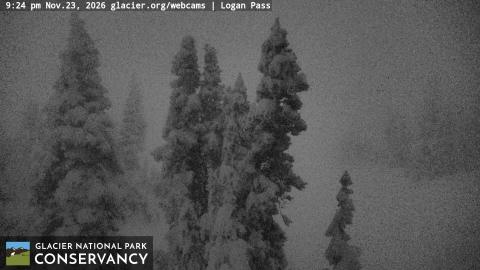
This second camera at Logan Pass makes two views a day. At dawn it aims east down the St. Mary valley to catch the sunrise, then it swings toward the meadows beneath Mount Reynolds, a pointed peak beside the pass, where a short paved nature trail leaves the visitor center.
The foreground is a slope of firs and meadow at more than 6,600 feet, and in a storm the lens collects snowflakes that blur the trees behind. On clear summer mornings it is the camera to open for the peaks; in shoulder seasons it shows whether the high country has turned white.
On the Continental Divide
The pass is named for William R. Logan, the first superintendent of the park. Westerly winds push enormous amounts of snow over the Divide here, and just east of the pass a slope called the Big Drift often holds more than 100 feet of it. Clearing the road takes plows and crews most of the spring, and the pass usually opens only from late June or July to mid-October; winds of more than 130 mph have been measured here. In summer the meadows fill with wildflowers, and mountain goats and bighorn sheep graze around the visitor center, used to people.
The trails
Two of the park's most popular hikes start at the pass. The Hidden Lake trail climbs gently over boardwalks and meadow to an overlook above Hidden Lake, about 1.4 miles away. The Highline Trail heads north along the Garden Wall, a ledge cut into the cliffs above the road.
When to watch Logan Pass
The pass keeps Mountain Time: UTC−7 in winter and UTC−6 in summer. The sun rises between about 5:30 a.m. in mid-June and 8:30 a.m. at New Year, and sets between about 4:40 p.m. in mid-December and 9:40 p.m. in late June. Summer mornings show the parking lot filling up, often before 9 a.m. In late September and October the cameras catch the first storms that close the high road for the winter.
Around Logan Pass
The pass is one of the corners of Glacier National Park; St. Mary, at the east end of the road, is about 18 miles away, and Apgar, at the foot of Lake McDonald, about 32 miles to the west.
Visiting Logan Pass
There is no other way up than the Going-to-the-Sun Road, which is narrow and winding near the top and limits the length of vehicles. The visitor center is open only in summer, and there are no services at the pass in the off-season. Bring warm layers even in July: the weather on the Divide changes fast, and snow can fall in any month.