What the Kitty Hawk live cams show
The Kitty Hawk surf straight out from the dunes
Twiddy & Company, an Outer Banks vacation rental company, streams this view from an oceanfront spot in Kitty Hawk. The camera looks straight out to sea over a sand fence and dune grass at the bottom of the frame. Below lies a wide, flat beach, then the line where the waves break and the open Atlantic running to a clean horizon. With no buildings or piers in the shot, it is all about the water: how big the sets are, whether the sea is glassy or whipped up by the wind, and how far up the beach the tide reaches. The beach faces east, so the sun comes up over the water right in front of the camera, the best moment to tune in.
The town behind the famous name
The name is usually traced to an Algonquian word, recorded as chicahauk, for a place to hunt geese; the spelling Kitty Hawk was made official in 1959. Around 1900 it was a small fishing village with a weather station, and it was the address the Wright brothers used. They camped on the dunes about 4 miles south, and after their first powered flights in December 1903 they walked back to Kitty Hawk to send the news to their father by telegram, so the world remembered the flights as Kitty Hawk's. The name later went to an aircraft carrier and to the Apollo 14 command module, though the town itself was incorporated only in 1981. Its oceanfront is lined with older cottages along NC 12, the Beach Road, a stretch where storms sometimes push sand and seawater over the pavement.
When to watch Kitty Hawk
Kitty Hawk keeps Eastern Time, like New York: UTC−5 in winter and UTC−4 in summer. The beach faces east, so sunrise over the Atlantic falls between about 5:45 a.m. in mid-June and about 7:25 a.m. in winter, and sunset, behind town over Kitty Hawk Bay, between about 4:50 p.m. in early December and about 8:25 p.m. in late June. Expect water in the mid 40s °F in winter and the upper 70s °F in August. Hurricane season lasts from June to November, but nor'easters in fall and winter often reshape the beach just as much.
Around Kitty Hawk
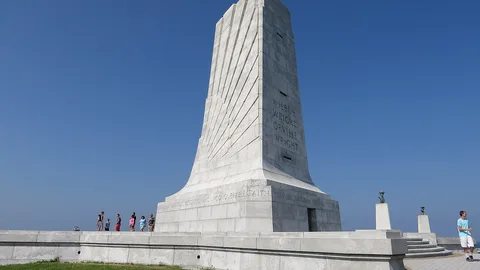
Kitty Hawk Woods Coastal Reserve protects about 1,900 acres of maritime forest, swamp and marsh on old dune ridges, with trails under live oaks and loblolly pines. The Kitty Hawk Life-Saving Station, one of the posts that once watched this dangerous coast, still stands near the beach. The Wright Brothers National Memorial is a short drive south in Kill Devil Hills.
Visiting Kitty Hawk
Norfolk International Airport (ORF), in Virginia, is about 75 miles away. US 158 crosses Currituck Sound on the Wright Memorial Bridge and runs through town parallel to NC 12. Rip currents are a real risk on Outer Banks beaches: swim where lifeguards are on duty and stay out of the water when red flags fly.