What the Kaanapali live cams show
Kaanapali Beach and the reef, from Black Rock
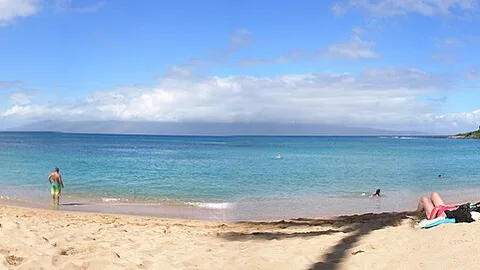
Mounted at the Sheraton Maui, on Black Rock at the north end of the main beach, this camera moves between several positions. In one, it looks south down the full length of Kaanapali Beach: hotel towers and palms on the left, umbrellas and sunbathers on the wide sand, and waves breaking white along the shore on the right. In another it sits low over the water near the rock, where swimmers and snorkelers gather and a catamaran pulls up on the sand, with the reef line and boats farther out.
It shows what the beach is like right now: how crowded it is, how the waves are breaking and whether the snorkeling water by the rock looks clear. Late afternoon brings the warmest light down the beach.
North Kaanapali Beach from above, toward Black Rock and Lanai
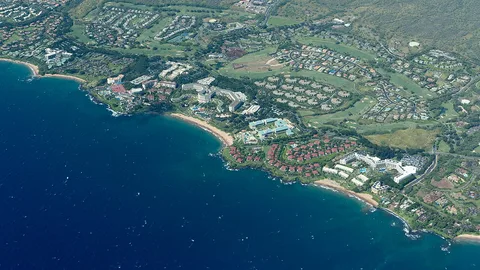
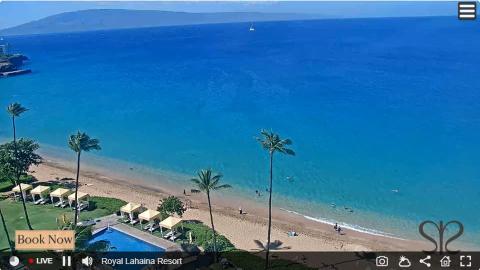
The Royal Lahaina Resort, at the quiet north end of Kaanapali, keeps this camera high on one of its buildings. Below are the resort's pool, a row of white cabanas on the lawn and tall coconut palms; then the beach, with swimmers along the waterline, and water that turns from pale turquoise over the sand to deep blue. Looking south down the coast, the dark headland at the left edge is Puu Kekaa, Black Rock, and the long, low island on the horizon is Lanai.
It is the widest of the Kaanapali views, good for judging how calm the sea is, how many people are on the beach and how hard the wind is bending the palms. In winter, watch the open water for the spouts of humpback whales.
Puu Kekaa, the Black Rock
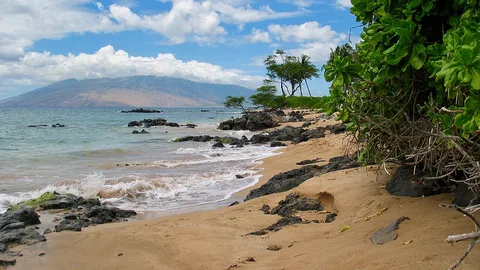
Toward the north end of the beach, a dark lava headland juts into the sea. Most visitors call it Black Rock; its Hawaiian name is Puʻu Kekaʻa. In Hawaiian tradition it was a leina, a place where the souls of the dead leapt from this world into the next. Kahekili, the last ruling chief of an independent Maui, is remembered for leaping from its cliff into the sea, a feat only a man of great mana could survive. The hotel built on the rock has long marked sunset with a torch-lighting and a dive from the top. The clear water along its face is one of West Maui's best-known snorkeling spots, where green sea turtles come to feed.
When to watch Kaanapali
Hawaii keeps Hawaii-Aleutian Standard Time (UTC−10) all year, with no daylight saving: 3 hours behind the West Coast and 6 behind the East Coast in summer, 2 and 5 in winter. The sun rises behind the West Maui Mountains, between about 5:45 and 7:05 a.m., and sets over the sea between about 5:45 p.m. in late November and 7:10 p.m. in early July. Mornings are usually the calmest; the trade winds tend to roughen the water after midday. From roughly December to April, humpback whales spend the winter in the channel offshore, and their spouts can show up far out on the cams.
Around Kaanapali
A paved beachfront walk links the resorts and Whalers Village, the shopping center in the middle of the beach. A few miles north lie the quieter bays of Napili and Kapalua. To the south is Lahaina, once the royal capital of the Hawaiian Kingdom and later a whaling port. Most of the town was destroyed by wildfire in August 2023; it is a community first, so check local guidance before planning a stop.
Visiting Kaanapali
The small Kapalua airport (JHM) is a few minutes north, and Kahului (OGG), the island's main airport, about an hour's drive away. Waves can break hard right on the sand in places, so watch the water before going in. Stay at least 10 feet from turtles in the water and on the beach.