What the the Georgia Aquarium live cams show
Eagle rays, jacks and reef fish in a 6.3-million-gallon tank
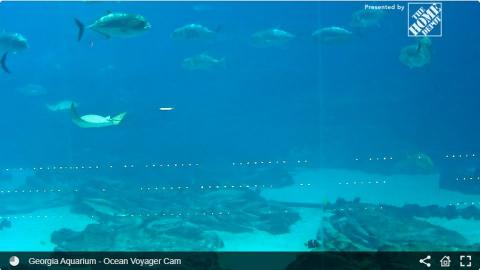
This camera looks through the great acrylic window of Ocean Voyager, the Georgia Aquarium's largest exhibit and one of the biggest single aquarium tanks in the world. Rockwork and pale sand fill the bottom of the picture, crossed by rows of small lights reflected in the window. Above, the blue water is rarely empty for long: spotted eagle rays flap past, schools of big silver jacks sweep across the frame, and smaller yellow and striped fish drift in between. The tank was built for the aquarium's whale sharks, and they share it with manta rays, so the largest fish in the sea can cruise into view at any moment. It rewards a few minutes of watching, since the big animals come and go on long laps around the tank.
Sand tiger sharks gliding through a cloud of small fish
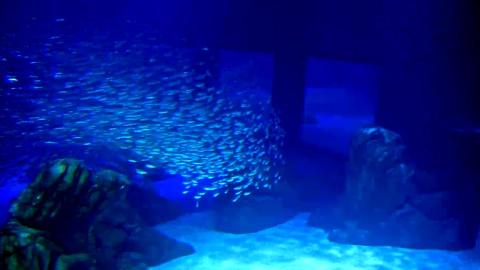
In Sharks! Predators of the Deep, which the Georgia Aquarium counts among the largest shark exhibits in North America, this camera looks into deep blue, dimly lit water over a sandy floor and dark rockwork. Most of the picture is taken up by a huge school of small silver fish that tightens and swirls as the predators pass. Sand tiger sharks, long and bronze-gray with pointed snouts, cruise slowly through the school, sometimes so close to the lens that a fin or a tail blacks out a corner of the frame. Pale square panels glow in the back wall. The lighting is kept low, like water far below the surface, so the view is moody rather than bright; give it a minute and a shark will come by.
White whales swimming past an underwater window
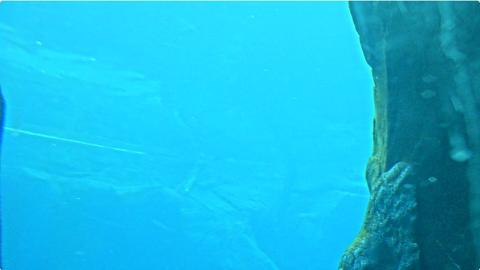
Underwater in the beluga habitat of Cold Water Quest, the Georgia Aquarium's gallery of animals from the coldest seas, this camera looks out between two dark walls of rockwork into bright, milky-blue water. The belugas swim on a circuit, so for a while the frame can hold only light and ripples, and then a white head with its rounded melon slides into view, followed by the long pale body, and often another whale close behind. Belugas, unlike most whales, can bend their necks and turn their heads. The water is cloudy and the picture soft, so it is a camera for watching the animals move rather than for detail; leave it running a few minutes to catch them passing.
Amber jellies drifting in bright blue water
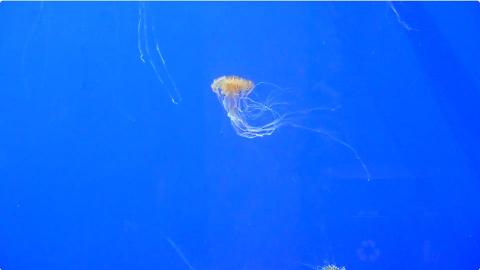
The Georgia Aquarium keeps this camera on one of its jelly tanks, and the picture is almost nothing but color: a flat, bright blue that fills the whole frame, with the faint curve of the tank wall showing through. Against it, a handful of jellies with amber, striped bells hang at different depths, trailing long white tentacles and frilly arms several times their own length. Some pulse slowly upward, others sink or turn on their side, and now and then one drifts close enough to fill a corner of the screen. With no fish, rock or sand in view, it is the quietest of the aquarium's cams, and the one most worth leaving on in a corner of the screen.
An aquarium built around whale sharks
The aquarium opened in November 2005, paid for largely by a gift of about $250 million from Bernie Marcus, a co-founder of The Home Depot. It stands on Pemberton Place, land donated by Coca-Cola next to Centennial Olympic Park, and from the start it was designed around one animal: the whale shark, the largest fish in the sea. Its Ocean Voyager exhibit holds 6.3 million gallons of salt water, and visitors walk under it through a 100-foot tunnel before reaching the great window, where whale sharks and manta rays cruise among thousands of smaller fish.
The galleries
The building is laid out as a ring of galleries around a central hall. Ocean Voyager is the largest. Cold Water Quest gathers animals of cold seas, from beluga whales and sea otters to African penguins. Sharks! Predators of the Deep, opened in 2020, is home to sand tiger sharks, hammerheads and a huge school of fish. Tropical Diver recreates a Pacific reef, River Scout follows rivers from Georgia to Africa and South America, and Dolphin Coast holds the dolphin presentation.
When to watch the cams
The cams look into the galleries the visitors see, and the animals keep to the aquarium's day: the lights are up and the tanks are busiest from morning to evening, Eastern Time (UTC−5 in winter, UTC−4 in summer). Feeding times bring the most movement, above all in Ocean Voyager, when keepers feed the whale sharks and divers clean the window.
Visiting the Georgia Aquarium
The aquarium is a short walk from the downtown MARTA stations, and it shares its block with the World of Coca-Cola and the National Center for Civil and Human Rights. Tickets are sold for timed entry, and weekday mornings outside school holidays are the least crowded. Hartsfield–Jackson Atlanta International Airport (ATL) is about 10 miles south, linked to downtown by MARTA trains. For the rest of the city, from Buckhead to the Martin Luther King Jr. National Historical Park, see the Atlanta live cams.